Thursday, March 22, 2007

Joe Wineke and John Gard Sitting In A Tree...

Say it ain't so, Joe!

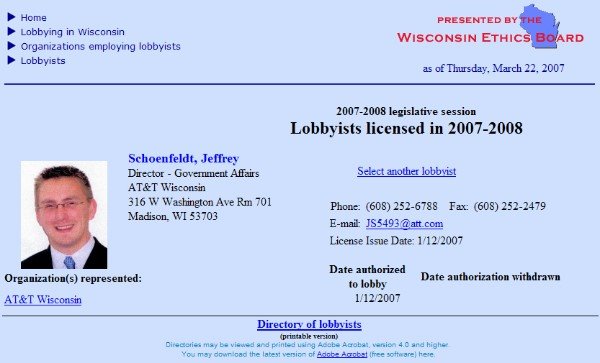
Politics certainly makes for strange bedfellows, but here's an unusually odd pair: Joe Wineke and Jeff Schoenfeldt. Joe wrote a letter, published in today's issue of the Fitchburg Star, endorsing Jeff for Fitchburg city council.

Only thing is, Joe is the chair of the Democratic Party of Wisconsin, and Jeff just happens to have been a longtime aide to none other than Republican John Gard!

Since Joe would never endorse a Republican, much less one who spent years carrying water for John Gard and friends, I'm sure that Jeff must have very recently undergone a miraculous conversion into a true-blue, card-carrying Democrat. Right?

Or maybe it has something to do with AT&T. You see, Jeff is a lobbyist for AT&T, and it looks like Joe has also fed at the AT&T trough. A little birdie told me that a high AT&T muckety-muck personally asked Joe to get involved in the Fitchburg race, so as a favor Joe obliged.


AT&T is working really hard right now to make, or buy, as many political friends as possible in order to persuade the legislature to pass, and Doyle to sign, the "Screw Everyone in Wisconsin Act", although they prefer to call it the Montgomery-Plale Cable Video bill.

This astonishing piece of legislation takes so much from Wisconsin consumers and taxpayers, and gives so much to AT&T, that it wouldn't stand a snowball's chance in hell if not for all of AT&T's newfound friends in high places. Friends who are willing to sell out the people they represent in order to cash in on the AT&T gravy train. I certainly hope Joe isn't in that group, but it's really up to him to show where he stands.

It's bizarre that Joe didn't think anybody would notice the chair of the Democratic Party of Wisconsin endorsing a John Gard Republican, and realize that it might make some Democrats just a little bit upset. But hey, it's a nonpartisan race, so maybe Joe figured that makes it all OK.

The other candidate in the Fitchburg race is a Libertarian named Jay Allen. From what I can tell, Allen, though far from perfect, would be preferable to Schoenfeldt from the point of view of most Democrats, something Joe really should have looked into before he publicly inserted his foot into his mouth.

Tuesday, March 20, 2007

The Costs of War

As a liberal who is strongly and actively opposed to the war in Iraq, I've been challenged many times as to why I didn't serve in the military. Although I've never shared my story before, and it's difficult for me to write this now, it is perhaps the appropriate time. Today marks the 4th anniversary of the start of the Iraq war, and it seems only now are many of the physical and mental costs paid by those who have fought in Iraq becoming apparent to the American people. But all wars extract a similar toll, and my tale is that of the terrible price paid by an American soldier, and his family, in another unnecessary and immoral war a generation ago.

If you've been following the Walter Reed Army Medical Center scandal you've probably seen the following quote by George Washington:

"The willingness with which our young people are likely to serve in any war, no matter how justified, shall be directly proportional to how they perceive the Veterans of earlier wars were treated and appreciated by their nation."
Powerful words. They've been engraved on memorials and cited by dozens of veterans groups, members of congress, and US senators, including presidential candidates Barack Obama and John McCain. They have a very personal meaning for me.

I'm an Army brat. Both my parents were in the military, and my father was a major in the US Army Special Forces, a Green Beret. He served on and off for nearly ten years in Vietnam and Southeast Asia, starting in the late 1950s, and during that time he developed a progressive psychosis that today would probably be diagnosed as PTSD. But back then there was an unwillingness, particularly among elite forces, to accept that combat stress often causes mental illness, and there was a severe stigma attached to any service member who sought or accepted what little treatment was available. Symptoms were often ignored or discounted, and you pretty much just had to deal with it and get better on your own.

Or not. Despite the best efforts of my mother, who spent a couple of years trying to get the Army to recognize that my father was slowly deteriorating mentally, they refused to even evaluate him. My father, of course, denied there was anything wrong, because admitting to it would have ended his beloved military career. As long as he was more or less able to do his job the Army could, and did, pretend that he couldn't possibly be mentally ill, and therefore the problem was really just my mother, who was upset that he was being sent on so many combat tours away from his family.

The result was sadly predictable. When I was nine years old the whole facade crumbled. After a series of increasingly violent incidents involving my father, incidents that were intentionally covered up or minimized by the Army, something finally happened that they couldn't brush aside. First-degree attempted murder, three counts.

My father's intended victims? My mother and two other family members.

The Army, no longer able to deny or hide the fact that my father had become dangerous and unpredictable, took him into custody and then institutionalized him. They finally accepted that my mother had been right all along, but it was far too late for any sort of happy ending. My father's illness was by then so advanced, and he was considered such a threat to medical staff, that the "treatment" they recommended for him was a lobotomy followed by indefinite confinement. Although my mother was able to block the lobotomy, at that time there was very little that could be done to help someone in my father's condition, and he remained institutionalized for many years. Our family was devastated, and I never saw my dad again after his arrest on that winter's night in 1967.

By neglecting to respond to my father's clear symptoms of developing mental illness, and continuing to send him back into combat despite all the warning signs, the Army destroyed a great man. A man who proudly and willingly dedicated his life to serving our country. A man who, in return, deserved not only the appreciation of his county, as Washington said, but also the concern and care that might possibly have prevented his descent into insanity and all the suffering that resulted.

No matter how you feel about the war in Iraq, we have a sacred obligation to care for those we send to fight and die for us. We can afford to lose in Iraq, but we can't afford to let this war break our military. In part because we've succeeded so well in using technology to improve the survival rate of severely wounded soldiers, the single largest cost of this and all future wars will be medical care for soldiers and veterans. If we are not willing to accept and pay that price, and to do whatever is humanly possible to heal our sick and make whole our injured, then we have no right to ask our military men and women to risk their lives on our behalf. And if we ask anyway, the day may come when they no longer answer.

My life has been shaped by the failure of our country to fulfill its responsibility to one particular soldier forty years ago. The personal cost of that failure to my father, my mother, my brothers and sister, and to me, has been quite high. But there was also a cost to our country. A cost that is particularly relevant today as we scrape the bottom of the barrel to find more troops to send to Iraq.

Because of the way I saw my father treated, I did not follow his footsteps into the military, nor did any of my siblings. Our proud heritage as a military family came to an end. Washington's prophetic words, spoken more than two hundred years ago, had proven true.

-----------------------------------------------------------------------

More about the quote from George Washington in a later post.

Tuesday, February 27, 2007

Double Whammy for Wisconsin Voter ID Bill

Voter ID is in the news once again in Wisconsin. Assembly Republicans are trying to push it through over the objections of Governor Doyle and the Democratic Senate. But their job just got a heck of a lot tougher because the first scientific data on the effects of voter ID was officially released, and it's a double whammy for the Republicans. Not only does the study show that voter ID very significantly reduces overall turnout, but it also shows that the Wisconsin bill is actually more likely to cut white turnout than minority turnout.

Now, I would never accuse my good Republican friends of pushing voter ID for political gain, but somehow I suspect that they won't be quite as enthusiastic when they realize that the political party most likely to be hurt by the law is their own.

The study, conducted by researchers at Rutgers and Ohio State for the US Election Assistance Commission, was completed last June but not publicly discussed by the Commission until earlier this month. It showed that tough voter ID requirements cut overall voter turnout by nearly three percent, black turnout by nearly six percent, and Hispanic turnout by ten percent. But requiring a photo ID, as opposed to other methods such as non-photo ID's or signature matching, cut white turnout far more than minority turnout. Bummer, if you're a Wisconsin Republican.

The full study was actually released last summer but nobody noticed, perhaps because it's kind of tough reading unless you're a masochist. Within the last couple of weeks both USA Today and The New York Times have done articles about the study, although the most interesting write-up I've seen is on this blog. But all of these reports skip over a lot of the details important in Wisconsin, such as the relationship between turnout reduction and the specific type of voter ID. You really need to push through the study if you want to find the good stuff.

This study also didn't examine the rate of fraudulent voting, so it wasn't able to compare the number of valid votes lost due to stricter voter ID requirements to the number of fraudulent votes prevented. But based on the overall findings, the proposed Wisconsin voter ID bill would reduce turnout by perhaps fifty-thousand votes, and it's kind of hard to imagine that there could be anywhere near that many fraudulent votes here.

I've always thought that the basic question voter ID supporters must be willing to answer is how many good votes they're willing to sacrifice to prevent one bad vote. Compared to most other democracies we already have a very low voter turnout, due at least in part to long-standing efforts to disenfranchise one group of voters or another, yet democracies can only work when government has the informed consent of its citizens. Seems to me that we should be doing everything possible to get as many people as possible to the polls, not the other way around.

Yes, we must always be watchful for fraud, but every fraud prevention technique should be judged solely by how it effects the integrity of our democratic process. If a stricter voter ID requirement eliminates more good votes than fraudulent votes, or if it has disproportionate effects on particular groups of voters, then it's a failure. Based on the data now starting to come out, the proposed Wisconsin voter ID law is not likely to meet this standard and should be reconsidered. Here's how the authors of the study put it:
"This research also is unable to answer the question of whether stricter voter identification requirements succeed at preventing vote fraud. The results, instead, tell part of the story. It appears that stringent requirements can reduce turnout. But it remains to be seen whether the reduction in turnout is the price to pay for greater ballot security. That may, indeed, be the case. But it is also possible that strict voter identification requirements, designed to promote legitimate election results, could actually undermine that legitimacy instead."
----------------------------------------

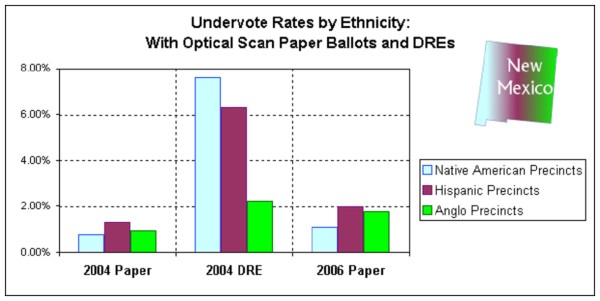
Speaking of voting issues that have a disproportionate effect on particular groups, there's some very interesting data just out from New Mexico. In 2006 New Mexico scrapped all their touchscreen voting machines and switched to using only hand marked ballots with optical scanners, so the good folks at Voters Unite thought it would be interesting to retrospectively examine the change and see it had actually made any detectable difference in voting patterns.

The results were rather shocking. They found that DRE (Direct Record Electronic) touchscreen machines had a top-ticket (president of governor depending on the year) undervote rate that was typically three to four times higher than paper ballots. But strangely enough, that huge undervote discrepancy only occurred in precincts that were predominantly Hispanic or Native American. There was little difference in white areas. Check out this chart from the report:


Voters Unite didn't even speculate about why this occurred, but it's pretty clear from this and many other cases that weird things happen with touchscreen machines, and they need a heck of a lot closer scrutiny than they've received so far. Perhaps it's just a coincidence that Republicans love both tough voter ID laws and touchscreen voting machines, but given that in almost every case the resulting changes in voting patterns tend to directly benefit them, it kind of makes you wonder...

Read more about this on Brad Blog.

Monday, February 26, 2007

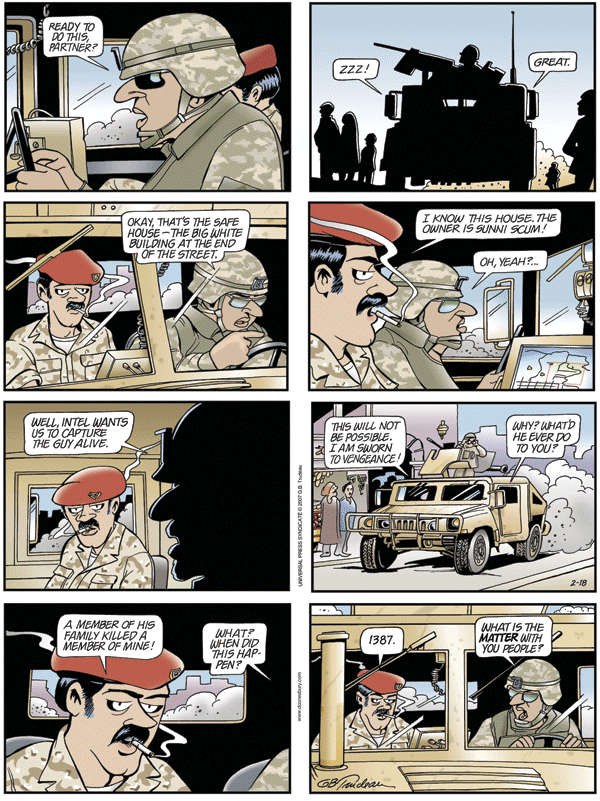
Why We'll Never Win In Iraq


Read Doonesbury every day at Slate.

For a superb analysis of what the hell we're really doing in Iraq check out Sy Hersh's new article in The New Yorker. Hersh has written by far best review yet of our convoluted Middle East policy, and some of his findings are shocking, including ongoing US support for Al Qaeda and an explanation of where some of those billions of aid dollars missing in Iraq went. (Hint - they're connected!)

Friday, February 23, 2007

What Is A 'Strong-Party" Democrat?

If you read my posts here or on other forums you know that I often refer to myself as a "strong-party" Democrat. What does that mean? And why is it important?

Simply put, strong-party refers to a political philosophy or model based on the belief that you generally get more votes by clearly differentiating yourself from your opponents through taking strong stands on values and issues. This motivates and brings out your base, attracts independents who prefer strong leaders, and advances your political agenda, although at the risk of driving away voters who don't agree with you.

The opposite of the strong-party model is the cautious-party model, which is the dominant model in the Democratic Party today (although that's starting to change). This model holds that the path to political success is to blur the distinction between you and your opponents by taking vague general positions and avoiding controversial issues. The goal is to get as many votes as possible by not offending anyone. The main drawback is that you tend to be seen as weak, so it's hard to motivate your base and you lose independent voters who value leadership above ideology. It also makes it harder to advance your political agenda, and increases the risk of a third-party challenge.

Notice that all this has nothing to do with ideology. It isn't about left verses right, but rather two very different strategies for political success. John Kerry is a cautious-party liberal, and Joe Lieberman is a cautious-party moderate. Dennis Kucinich is a strong-party liberal, and Howard Dean is a strong-party moderate.

Despite the fact that I'm a liberal who is often at odds with moderates, I believe that the real fight within the Democratic Party is philosophical, not ideological. What is generally perceived as a left/right division is actually a fight over fundamentally differing views of what the Democratic Party is, and what we must do in order to succeed.

There are valid historical reasons why the Democratic Party is dominated by cautious-party politicians and leaders, but politics in the US has fundamentally changed over the last thirty years, and we as a party haven't kept up. It's time to have this debate and start moving our party forward.

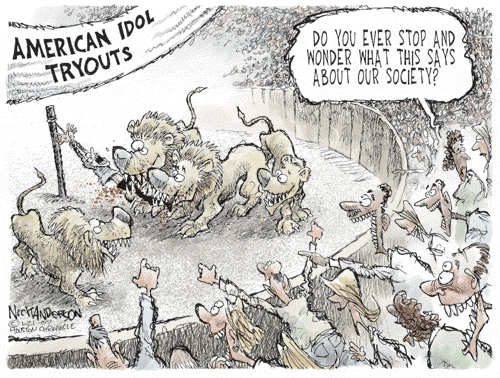
American Idol

It's a shame that Denise Jackson didn't make it further on American Idol, but this cartoon sums up my feelings about that show rather well.

Wednesday, February 21, 2007

UW Madison College Dems: No Blacks Allowed?

Are blacks and Hispanics welcome in the UW Madison College Democrats? You might not get that impression judging from the bizarre antics at their endorsement meeting a few weeks ago.

In one of the most boneheaded maneuvers ever, the College Dems' leadership, in their zeal to support a favored candidate for Madison City Council, took unprecedented measures that prevented almost every single minority student at that meeting from participating in the endorsement vote. The College Dems weren't deliberately being racist, but perception is reality in politics, and it looks really bad when a bunch of white Democratic students change the rules at the last minute to block a bunch of black and brown students from voting at a party meeting. Not exactly the best way to encourage minority involvement in the Democratic party.

This is a complicated story that hasn't been covered well in the MSM, and I know I'm going to stir up a hornet's nest by wading into it. But I firmly believe that Democratic leaders, even students, must be held accountable when they do things that hurt the party.

There's an additional reason that I'm bringing up this issue now. This Thursday the Dane Dems will hold an endorsement vote on the same city council race. Usually we simply follow the lead of the College Dems, but this year I believe that we need to carefully consider the fact that doing so implies tacit approval of the tactics used at the College Dems meeting, and therefore will only compound the damage. Given that both candidates in the race are well qualified progressives with almost identical stands on the issues, I think the Dane Dems should just stay out of this mess and let the cards fall where they may.
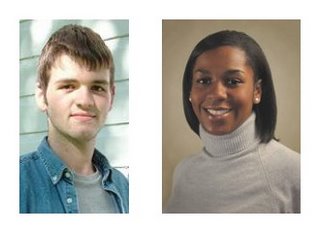

Here's the story:

Eli Judge (L) and Lauren Woods (R) are competing for the Madison 8th District City Council seat currently held by retiring alder Austin King. This district covers many of the UW Madison dorms, so it's quite liberal even by Madison standards, and tends to elect very young candidates.

Both Woods and Judge are UW students with solid political experience; Woods was president of the Wisconsin Black Student Union and has worked for Senator Lena Taylor, and Judge was Chair of UW-Madison Students for a Fair Wisconsin. Both are progressive activists who's views reflect those of the district, and both are well qualified to serve on the City Council.

The retiring King recruited Woods as his heir apparent, and delayed his retirement announcement as long as possible to discourage other challengers. King is very popular, and has a formidable political machine in the district, and Woods has the strong support of many minority groups on campus. But Judge, with the backing other groups and, critically, the College Dems leadership, also threw his hat into the ring. With two ideologically similar candidates vying for the seat it promised to be a tough race, boosting the importance of endorsements.

But the College Dems leadership faced a problem. They couldn't guarantee that Judge, their favored candidate, would receive their endorsement under the rules they traditionally used for endorsement votes. The College Dems have always allowed everyone who showed up a meeting to vote. Endorsements were decided largely by how many supporters each candidate could bring to the endorsement meeting, and it was probable that Woods, with support from King's machine, would be able to turn out far more people than Judge.

Faced with this the College Dems leadership took two unprecedented actions: They scheduled a snap endorsement meeting with only two days public notice, and they simultaneously announced a change in the voting rules to require attendance at a previous College Dems event as a prerequisite to vote.

The effect was to prevent almost all of Woods supporters from voting. Given the groups that support each candidate, it came down to a bunch of white students telling a bunch of black and brown students that under the brand new rules they were no longer entitled to vote for their own candidate.

I don't have a problem with the College Dems adopting any rules they want. But I do have a problem with them changing them at the last minute to help their buddies, particularly when doing so drives a wedge between the Democratic Party and the minority community.

But there's a bigger problem here. Some of our Democratic party leaders are not only completely oblivious to the racial overtones in this case, they also appear to be supportive of what the UW Madison College Dems did and how they did it. This "win at any cost" culture, while necessary for a political party to succeed, tends to obscure the fact that some battles just aren't worth the cost. A "damn the torpedoes, full speed ahead!" attitude is great most of the time, but you still have to think about the consequences of damning those torpedoes, and many of our party leaders are incapable of doing so. They tend to think very short term, tactically rather then strategically, and this leads to errors in judgment. Sadly, those errors can really damage our party.

I want to make it very clear that my objection isn't to Eli Judge as a candidate. Although I prefer Lauren Woods for many reasons, I believe that either candidate would do a good job representing their district on the city council. My beef is with the utter stupidity of the College Dems board members and the adults who advised and supported them.

Here are some links from both sides of the issue if you want more information. Be sure to read the comments on the stories to get a flavor of the strong feelings this race has generated:

The Badger Herald 1/19/07 - UW students go head-to-head for District 8 seat. A good intro to the race.

The Badger Herald 1/24/07 - College Dems endorse Judge. This is the original news story about the College Dems endorsement. It doesn't mention the controversy at all.

Badger Herald 01/30/2007 - UW Dems limit Woods’ support. This is the first story that talks about the voting rule change.

The Daily Cardinal 2/7/07 - UW Dems bylaw change unfair to Woods, some say. Another story that gets into the rule change.

The Critical Badger Blog 2/7/07 - The Daily Cardinal… what are you thinking?. A critique of the story above by a member of the College Dems. I believe the "Bloggers in the area [that] will be going crazy with this story" refers to me.

Lauren Wood's campaign website

Eli Judge's campaign website

A final word. I've talked to many people on both sides of this issue, and while everyone schemed behind the scenes to support their own candidate, it's my opinion that the UW Madison College Dems board and particularly their chair, Eli Lewein, have been considerably less than honest about their actions and motivations. Although much of the blame must be placed on the adults within the Democratic Party who are selecting and mentoring the College Dems leadership, that doesn't excuse either what they did or their unwillingness to accept responsibility for the consequences of their actions. This incident exposes a serious flaw in the way we recruit and train future Democratic Party leaders, a flaw that must be fixed if the party is to be truly successful in Wisconsin.

------------------------------------------------

UPDATE: Although the Dane Dems board recommended an endorsement of Eli Judge, the endorsement did not pass at the general membership meeting on 2/23. Unfortunately Judge's endorsement was lumped in with several other endorsements that were voted on as a group, so there was little debate. I would have preferred to have seen a robust discussion of the issues, but I think we did the right thing by staying out of this race.

Madison Primary Results

In general I'm pleased with the Madison and Dane County primary results. The only really disturbing race is the Supreme Court. Although Linda Clifford won the county with 44.6%, verses 38.3% for Annette Ziegler, I had expected her to do significantly better here. If Clifford can't win Dane County overwhelmingly in April she's not going beat Ziegler. The rest of the results:

Madison Mayor. As everyone expected, Dave walked away with it.
Mayor Dave - 57.5%
Ray Allen - 29.9
Peter Munoz - 9.9%
Will Sandstrom - 2.4%
Madison District 6 Alderperson. A complete blowout. This race is over.
Marsha Rummel - 67.9%
Carol Durocher - 15.3%
Adam Casey - 11.5%
Brooks McGrath - 4.7%
Madison District 10 Alderperson. An even bigger blowout.
Brian Solomon - 71.8%
Chris Ogden - 17.1%
Thomas McClure - 6.0%
Nick Dorneanu - 4.5%
Madison District 11 Alderperson. An impressive performance by Chris Schmidt against a fairly strong incumbent.
Tim Gruber - 46.4%
Chris Schmidt - 43.1%
Sandra Lynne Saul - 10.0%
Madison District 12 Alderperson. These number look good for Satya. She should pick up almost all of Mike Basford's votes (assuming Mike supports her, which he should) giving her a clear lead over Deadman in the general.
Mark Deadman - 34.3%
Satya Rhodes-Conway - 34.0%
Mike Basford - 28.6%
Marcus Watson - 3.0%
Madison District 13 Alderperson. Another lopsided blowout.
Julia Kerr - 73.7%
Duane Steinhauer (Progressive Duane) - 14.3%
Mike Clark - 10.7%
Madison District 15 Alderperson. Vicky has her work cut out for her in this one.
Larry Palm - 50.0%
Vicky Selkowe - 40.4%
Mark Schmitt - 9.2%
Madison District 17 Alderperson.
Joe Clausius - 55.4%
Sarah Florino - 22.6%
Mary Thornton - 21.1%
Madison District 18 Alderperson. Props to Olivas who never ran for office before. Despite his defeat I hope he stays involved in politics.
Michael Schumacher - 49.1%
Jon Becker - 36.4%
Benito Juarez Olivas - 10.4%
Andy Lindgren - 4.0%
Madison School Board Seat 3. I haven't seen Rick Thomas do much campaigning, but what he did clearly worked. I believe he is a fairly conservative Christian, and church support may have been his secret weapon.
Beth Moss - 50.0%
Rick Thomas - 26.3%
Pam Cross-Leone - 22.4%
Shame on you if you didn't vote today, and on to the general election!

Monday, February 19, 2007

Jail Time for Rep. Mark Pocan?

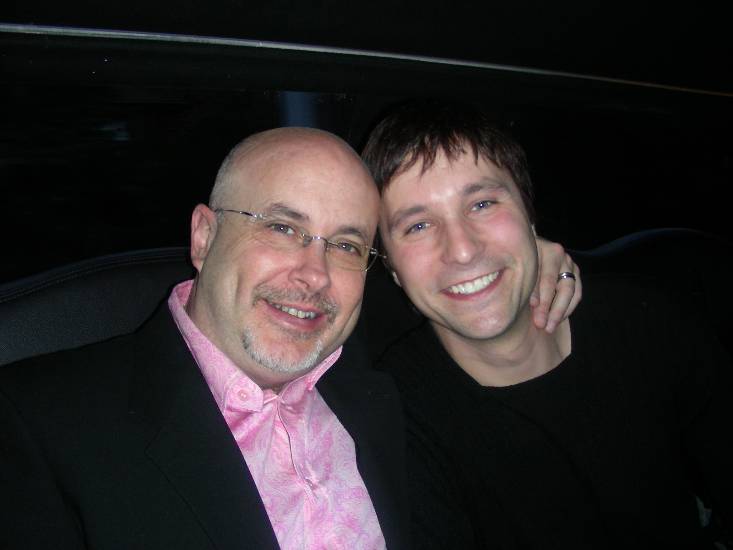
Representative Mark Pocan very publicly broke Wisconsin law, and if tried and convicted he faces thousands of dollars in fines and nearly a year in jail. His crime? Going to Toronto last November to marry his male partner.

Under an obscure Wisconsin law, anyone living in Wisconsin who goes to another state or country and gets married there, when such a marriage is not permitted in Wisconsin, is subject to criminal penalties and can be fined ten thousand dollars and thrown in jail for nine months.

Everyone knows that a marriage between two men or two women isn't legal in Wisconsin, and wasn't legal even before we amended our constitution to enshrine intolerance in that great document. But there's been little attention paid to the fact that it's also illegal for a gay or lesbian couple to travel out of state to get married. The Human Rights Campaign and Attorneys Against the Ban both picked up on it, but I haven't seen this discussed in the MSM or on any of the blogs I read.

Wisconsin Statute § 765.30 states:
(1) The following may be fined not more than $10,000 or imprisoned for not more than 9 months or both:
"(a) Penalty for marriage outside the state to circumvent the laws. Any person residing and intending to continue to reside in this state who goes outside the state and there contracts a marriage prohibited or declared void under the laws of this state."

Now, you might think this was put in place just to make life difficult for single-sex couples, but it wasn't. It appears to have been intended to prevent Wisconsinites from doing stupid things like going to Alabama to marry their fourteen year old first cousins. Unfortunately the law is broadly drawn, and Mark Pocan and probably many others have unintentionally broken it. While Mark and his partner have little to worry about because it's unlikely a DA in Dane County would bring charges against them, that may not be true in other parts of Wisconsin.

BTW, congratulations and best wishes to Mark and Philip. I hope their marriage, whether recognized in Wisconsin or not, is long and happy.

I'm Back!

I took a little unplanned break from blogging, but I'm back with a bunch of good stuff in the pipeline including some mighty interesting investigative journalism and some posts on local politics that will probably piss off a lot of people.

Writing isn't easy for me. My training is in science and engineering, and in my younger days I studiously avoided writing. I've grown wiser as I've grown older, but putting this blog together is still a lot of work for a dumb engineer with very limited language skills. Despite this I've had pretty remarkable success judging by the number of hits I get and how often my posts get picked up by WisOpinion and other big sites. I just want to say thanks to all of my readers. You're the reason I do this.

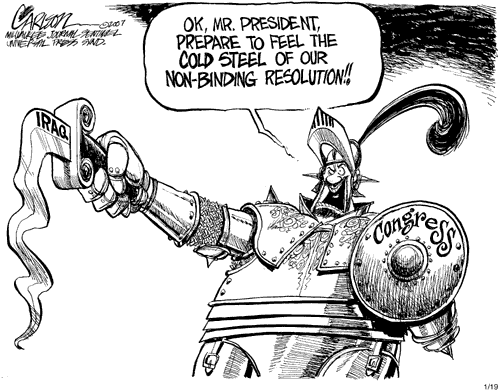
Non-Binding Resolutions...


But not bad for a first act...

Wednesday, February 14, 2007

McCain Voted to Kill the Federal Minimum Wage

I don't know if this got much coverage at the time, but it's so distressing that I thought I'd mention it. Senate Republicans tried to kill the federal minimum wage a couple of weeks ago. An amendment introduced by Senator Wayne Allard (R-CO) to the minimum wage increase bill had this little gem buried deep inside it:

State Flexibility.--Notwithstanding any other provision of this section, an employer shall not be required to pay an employee a wage that is greater than the minimum wage provided for by the law of the State in which the employee is employed...


Bob Geiger picked up on this

Here's the list of Senators that voted in favor of this amendment. Perhaps the most notable is preidential candidate John McCain. Just remember this the next time someone tells you how great McCain is.

Alexander (R-TN)
Allard (R-CO)
Bennett (R-UT)
Bond (R-MO)
Brownback (R-KS)
Bunning (R-KY)
Burr (R-NC)
Chambliss (R-GA)
Coburn (R-OK)
Cochran (R-MS)
Cornyn (R-TX)
Craig (R-ID)
Crapo (R-ID)
DeMint (R-SC)
Ensign (R-NV)
Enzi (R-WY)
Graham (R-SC)
Gregg (R-NH)
Hagel (R-NE)
Hatch (R-UT)
Inhofe (R-OK)
Isakson (R-GA)
Kyl (R-AZ)
Lott (R-MS)
McCain (R-AZ)
McConnell (R-KY)
Sununu (R-NH)
Thomas (R-WY)