
Matt Drudge linked to this Gallup Poll which claims to show that Republicans have significantly better mental health than Democrats. Conservatives will probably have a lot of fun with this, but the poll is probably worthless because Gallup doesn't address the single biggest source of inaccuracy in any such poll: Self-reporting bias.
Unless you know that conservatives are just as likely to report mental health issues as moderates and liberals, or you understand and correct for any such bias, the data is garbage. Given the stigma still attached to mental illness among more traditional social and religious groups, members of those groups are almost certain to underreport symptoms of mental illness. For a simple but good discussion of the some of the ways surveys and studies can be biased see this web page.
To understand self-reporting bias, consider a survey asking people if they're gay. How many conservatives, particularly religious conservatives, would admit being gay to a pollster when most of them can't even admit it to themselves. Think Larry Craig and you'll understand why Gallup probably has this wrong.
Friday, November 30, 2007


Monday, November 26, 2007
WI Senate Partisan Voter Index Ratings
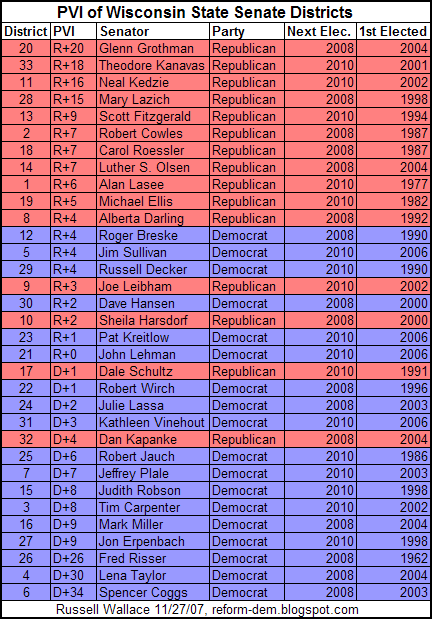
The scorecard above shows Wisconsin State Senate districts sorted from the most Republican to the most Democratic based on their Partisan Voter Index (PVI), which is a simple measure of how strongly a political district leans towards one party or another compared to the area as a whole. Red seats are Republican and blue are Democratic. PVI doesn't decide races, but it's a good measure of the overall political landscape.
Based on the chart it's easy to see which seats are likely to be toughest in 2008. For Dems it's going to be Breske and Hansen, and for Republicans it's going to be Kapanke. Breske's long tenure gives him an advantage, and Hansen was first elected in 2000 which helps, but Kapanke looks mighty vulnerable as a first term incumbent.
PVI was developed by Charlie Cook of the Cook Political Report specifically for comparing US congressional districts, so I'm taking some liberty by using the term for a similar measure of state electoral districts. The underlying statistical analysis is essentially the same except that the results are normalized to state rather than federal presidential election results.
To calculate the PVI for each district I totaled the presidential results for every ward in that district and then adjusted for the statewide results. There are more than 3500 wards in Wisconsin so this was a bit of a job although I automated much of it. I also simplified things by using only the 2004 presidential election. Cook uses the two most recent elections, but doing so would greatly increase the work required because I'd have to manually adjust for ward changes resulting from the 2002 redistricting. I don't exactly get paid for doing this stuff...
I'm working on a similar analysis for Assembly districts, so watch for that in the near future.
Monday, November 19, 2007
WI Presidential Head-to-Head Poll
Lots to blog about now that my race for Chair of the Democratic Party of Dane County is over. I'll talk about my defeat later, but I spotted this Survey USA poll and it's nice to see Wisconsin getting at least a little attention. All the usual caveats apply, keep in mind this is registered, not likely, voters, and unfortunately Edwards wasn't included:

(Click on image for larger version)
Clinton vs. McCain - Clinton wins by 2%
Clinton vs. Giuliani - Clinton wins by 7%
Clinton vs. Romney - Clinton wins by 16%
Clinton vs. Huckabee - Clinton wins by 17%
Obama vs. McCain - Obama loses by 4%
Obama vs. Giuliani - Obama wins by 5%
Obama vs. Romney - Obama wins by 12%
Obama vs. Huckabee - Obama wins by 17%
At this point the results are probably due more to name recognition and the generic Democratic advantage than "real" factors that will come into play as we get closer to the election next fall. Dems win every matchup except Obama vs. McCain. Clinton is significantly stronger than Obama against McCain and Romney, although not against Giuliani or Huckabee.
As usual, the real entertainment is in the crosstabs. For instance, Clinton crushes the Republican candidates among female voters. The gender gap is alive and well! But the age distribution contains good news and bad news. The good news is that young voters in Wisconsin are becoming strongly Democratic. The bad news is that they tend not to actually vote, at least compared to older voters. This means that any Wisconsin poll of registered voters, as opposed to likely voters, is probably going to be biased Democratic.
The age factor is mitigated somewhat here because voters 55 and up tilt significantly Democratic in most of these matchups, and they vote at higher rates than middle-aged voters. McCain is the exception because he has strong support among older voters. His actual numbers are probably a few percent better than the poll indicates, meaning he would likely beat Clinton as well as Obama here in Wisconsin.
-------------------------------------------------------------
I have some interesting projects on tap. I've calculated the Partisan Voter Index* (PVI) for each Wisconsin Senate district, and I'm working on the Assembly. This sort of data is hard to find for state races because it requires an analysis of election returns for each of the more than 3500 wards in the state. A lot of work, but I've automated much of it so it's only slightly painful. Political professionals have these numbers, of course, but they tend to be rather reluctant to share them.
My loss in the Dane Dems Chair's race also puts me in the interesting position of no longer being a member of the Dane Dems executive board. As a board member I was largely ineffective in achieving the changes and reforms I wanted, yet due to my position on the board I was reluctant to bring many of those issues to public attention. Those constraints no longer apply, opening up some intriguing new possibilities for building a bigger, better, and stronger Democratic Party.
*Technically the PVI as developed by Cook only applies to federal races, so I'm taking some liberties with the term even though the data analysis for state races is essentially the same as for federal races.

(Click on image for larger version)
Clinton vs. McCain - Clinton wins by 2%
Clinton vs. Giuliani - Clinton wins by 7%
Clinton vs. Romney - Clinton wins by 16%
Clinton vs. Huckabee - Clinton wins by 17%
Obama vs. McCain - Obama loses by 4%
Obama vs. Giuliani - Obama wins by 5%
Obama vs. Romney - Obama wins by 12%
Obama vs. Huckabee - Obama wins by 17%
At this point the results are probably due more to name recognition and the generic Democratic advantage than "real" factors that will come into play as we get closer to the election next fall. Dems win every matchup except Obama vs. McCain. Clinton is significantly stronger than Obama against McCain and Romney, although not against Giuliani or Huckabee.
As usual, the real entertainment is in the crosstabs. For instance, Clinton crushes the Republican candidates among female voters. The gender gap is alive and well! But the age distribution contains good news and bad news. The good news is that young voters in Wisconsin are becoming strongly Democratic. The bad news is that they tend not to actually vote, at least compared to older voters. This means that any Wisconsin poll of registered voters, as opposed to likely voters, is probably going to be biased Democratic.
The age factor is mitigated somewhat here because voters 55 and up tilt significantly Democratic in most of these matchups, and they vote at higher rates than middle-aged voters. McCain is the exception because he has strong support among older voters. His actual numbers are probably a few percent better than the poll indicates, meaning he would likely beat Clinton as well as Obama here in Wisconsin.
-------------------------------------------------------------
I have some interesting projects on tap. I've calculated the Partisan Voter Index* (PVI) for each Wisconsin Senate district, and I'm working on the Assembly. This sort of data is hard to find for state races because it requires an analysis of election returns for each of the more than 3500 wards in the state. A lot of work, but I've automated much of it so it's only slightly painful. Political professionals have these numbers, of course, but they tend to be rather reluctant to share them.
My loss in the Dane Dems Chair's race also puts me in the interesting position of no longer being a member of the Dane Dems executive board. As a board member I was largely ineffective in achieving the changes and reforms I wanted, yet due to my position on the board I was reluctant to bring many of those issues to public attention. Those constraints no longer apply, opening up some intriguing new possibilities for building a bigger, better, and stronger Democratic Party.
*Technically the PVI as developed by Cook only applies to federal races, so I'm taking some liberties with the term even though the data analysis for state races is essentially the same as for federal races.
Thursday, September 20, 2007
Reflections on Racism
When I was eleven or twelve I accidentally walked in on a poker game my uncle was having with a bunch of his buddies. They had been drinking all afternoon, and my uncle tended towards mean even when he was sober, so I tried to back out without getting noticed.
I didn't make it. My uncle spotted me, spun around, and suddenly I was looking down the barrel of his old Colt .45 revolver. He waved it around in my face and yelled "Know what this is boy? It's a nigger gun! Any niggers come 'round here and we're gonna take good care of 'em!" I was scared out of my wits, and it must have showed because the men all howled with drunken laughter. When my uncle finally got tired of his little game and put the gun down I cleared out of there in a mighty big hurry.
My uncle didn't live in rural Mississippi or Louisiana. This little incident happened about 1970 in a nice middle class Boston suburb. Even at that time, and even in the liberal northeast, my uncle's attitude wasn't that unusual, although few people expressed it so openly.
My uncle is dead, and his racism died with him. His children, now middle-aged, show no signs that they inherited their father's beliefs. His kids grew up in a time and place where racism, though still pervasive, was considered increasingly unacceptable. True racists rarely change, but they do eventually die, and that's how the world changes.
Given the recent events in Jena, I thought that it would be appropriate to reflect on how much has changed in our country, and how much more needs to be done. It's easy to forget just how far we've come in the last few decades, but it's even easier to overlook how much of a problem racism still is.
A good measure of overt racism is public attitudes towards interracial marriage. The Gallop Poll has tracked American views on that subject for almost fifty years. In 1958, the year I was born, only four percent of Americans approved of mixed race marriages. Today it's almost eighty percent. That's an astonishing change in less than two generations, yet one in seven Americans still has a problem with interracial marriage. The chart below shows the historical trend. Click it to see a larger version.

Today racism is usually more subtle. Discrimination persists in education, employment, housing, and law enforcement, but it's often masked by poverty. Conservatives, as well as some on the left, excuse these things simply as economic reality, the free market treating poor people like poor people, but there's more to it than that. All else being equal, skin color still is a big factor in where you start, and end up, in American society. (Yes, I can back that up with hard data if any of my conservative friends are wondering)
Beating racism is an unfinished job, and our biggest enemy is complacency. The problem is rarely as obvious as the events in Jena, but we must look beyond the individuals involved and focus on the culture that shaped their attitudes. In time the old racists in Jena will die out. Our real challenge is to ensure that they aren't replaced.
I didn't make it. My uncle spotted me, spun around, and suddenly I was looking down the barrel of his old Colt .45 revolver. He waved it around in my face and yelled "Know what this is boy? It's a nigger gun! Any niggers come 'round here and we're gonna take good care of 'em!" I was scared out of my wits, and it must have showed because the men all howled with drunken laughter. When my uncle finally got tired of his little game and put the gun down I cleared out of there in a mighty big hurry.
My uncle didn't live in rural Mississippi or Louisiana. This little incident happened about 1970 in a nice middle class Boston suburb. Even at that time, and even in the liberal northeast, my uncle's attitude wasn't that unusual, although few people expressed it so openly.
My uncle is dead, and his racism died with him. His children, now middle-aged, show no signs that they inherited their father's beliefs. His kids grew up in a time and place where racism, though still pervasive, was considered increasingly unacceptable. True racists rarely change, but they do eventually die, and that's how the world changes.
Given the recent events in Jena, I thought that it would be appropriate to reflect on how much has changed in our country, and how much more needs to be done. It's easy to forget just how far we've come in the last few decades, but it's even easier to overlook how much of a problem racism still is.
A good measure of overt racism is public attitudes towards interracial marriage. The Gallop Poll has tracked American views on that subject for almost fifty years. In 1958, the year I was born, only four percent of Americans approved of mixed race marriages. Today it's almost eighty percent. That's an astonishing change in less than two generations, yet one in seven Americans still has a problem with interracial marriage. The chart below shows the historical trend. Click it to see a larger version.

Today racism is usually more subtle. Discrimination persists in education, employment, housing, and law enforcement, but it's often masked by poverty. Conservatives, as well as some on the left, excuse these things simply as economic reality, the free market treating poor people like poor people, but there's more to it than that. All else being equal, skin color still is a big factor in where you start, and end up, in American society. (Yes, I can back that up with hard data if any of my conservative friends are wondering)
Beating racism is an unfinished job, and our biggest enemy is complacency. The problem is rarely as obvious as the events in Jena, but we must look beyond the individuals involved and focus on the culture that shaped their attitudes. In time the old racists in Jena will die out. Our real challenge is to ensure that they aren't replaced.
Friday, August 10, 2007
That's Gotta Hurt...
How can you tell when your presidential campaign is tanking? Well, it might be a hint if your support has dropped so much that voters in your own party are four times as likely to vote for a candidate from another party than for you.
In a poll just released by the University of Iowa, Barack Obama gets almost four times as much support from Republican voters in Iowa as John McCain does, 6.7% to 1.8%. McCain's support was 14.4% in March.
Ouch!
Turns out that among Iowa Republican voters Obama beats every Republican except Romney (21.8%) and Guliani (10%). Not bad for a Dem!
In a poll just released by the University of Iowa, Barack Obama gets almost four times as much support from Republican voters in Iowa as John McCain does, 6.7% to 1.8%. McCain's support was 14.4% in March.
Ouch!
Turns out that among Iowa Republican voters Obama beats every Republican except Romney (21.8%) and Guliani (10%). Not bad for a Dem!
Monday, August 06, 2007
Howard Dean at the 2007 YearlyKos Convention!
DNC Chair Howard Dean gave a great keynote address at the 2007 YearlyKos convention! Reminded me why I supported him for president four years ago. You can hear Dean using the player below (click twice if using IE), or download a high-quality (8 MB) mp3 by right-clicking on this link and saving. The speech is about half an hour long, but it's well worth the time.
You can also watch Dean's speech here, but it was streamed live and the video quality is pretty bad, more like a web cam than a regular TV feed. Unfortunately I haven't been able to find anything better.
Feel free to repost the mp3 or use it on your own site, but I'd appreciate credit and a link back to my blog. Thanks!
You can also watch Dean's speech here, but it was streamed live and the video quality is pretty bad, more like a web cam than a regular TV feed. Unfortunately I haven't been able to find anything better.
Feel free to repost the mp3 or use it on your own site, but I'd appreciate credit and a link back to my blog. Thanks!
Wednesday, July 18, 2007
Geopolitical History of the Worlds Major Religions - In 90 Seconds!
I'm not very good at memorization. That's one reason why I like to use graphs to put historical and political data into visual form. Here's a rather extreme but superb example of visual history from a website called Maps-of-War. I can't vouch for its accuracy, and it's rather simplified (although I guess that's what you'd expect when you cram 3000 years of history into 90 seconds), but it does seem to agree with what little I know of world religions. Enjoy!
Presidential Fundraising Skyrockets - But Dems Kick Ass!
I know, old pun. But take a look at the chart below I compiled from information released by The Campaign Finance Institute (great organization, check them out!). It compares presidential campaign fundraising, up to and including the 2nd quarter of the odd year preceding the election, for this and several previous election cycles.

It's rather shocking how much total fundraising has gone up. It's two and a half times higher now than at this point four years ago. But look at the Democratic/Republican trend. Comparing 1999, the last cycle with an open seat, to 2007, Republicans have almost doubled their fundraising, but Democrats have increased theirs by a factor of five!
Like it or not, and I don't, money buys elections. Democrats are now more than competitive in the presidential money race, and that does bode well for 2008.
There are lots more goodies in the Campaign Finance Institute report that I'll be writing about over the next few days, including small verses large donor info for all the current presidential candidates. Which major Democratic candidate raises a larger percentage of money from large donors than most Republicans? Stay tuned!

It's rather shocking how much total fundraising has gone up. It's two and a half times higher now than at this point four years ago. But look at the Democratic/Republican trend. Comparing 1999, the last cycle with an open seat, to 2007, Republicans have almost doubled their fundraising, but Democrats have increased theirs by a factor of five!
Like it or not, and I don't, money buys elections. Democrats are now more than competitive in the presidential money race, and that does bode well for 2008.
There are lots more goodies in the Campaign Finance Institute report that I'll be writing about over the next few days, including small verses large donor info for all the current presidential candidates. Which major Democratic candidate raises a larger percentage of money from large donors than most Republicans? Stay tuned!
Irony Part 2 - Do As I Say...
The entire Bush administration may be a bunch of incompetent idiots, but at least they're entertaining. This is word-for-word from a Voice of America (VOA) story. VOA is our government-sponsored overseas broadcast and news service:
"President Bush has signed an order that allows the U.S. government to block the assets of any person or group that threatens the stability of Iraq."
"The order exempts the United States".
Irony Part 1 - Supporting Our Troops
It seems President Bush objects to Congress' current attempt to give a 3.5% pay raise to our troops because it would cost too much. The logic behind Bush's position, as expressed in a "Statement of Administration Policy" he sent to Senate leaders: The extra pay for our troops is money "that would otherwise be available to support our troops".
You can't make this stuff up...
You can't make this stuff up...
Tuesday, July 03, 2007
Random Thoughts on Libby

1. Based on a Survey USA poll Bush's decision to commute Libby's prison sentence is opposed by about 60% of Americans who are familiar with the issue. My guess is that this will end up more like 70-30 when all is said and done. Of course, to a president with a 26% approval rating that thirty to forty percent must look pretty good.
2. The 40% who approve of Bush’s action or think he didn’t go far enough and should have given Libby a full pardon are traitors. Ask any CIA officer. I did.
3. Regardless of the opposition, Bush honestly believes this isn't going to hurt him politically. The administration typically announces damaging news late on Friday afternoons, yet they didn't do that in this case.
4. If I was in the CIA I'd be mad as hell. Bush just spit in the face of the CIA (again), and I'm not sure that's a smart move for somebody who needs the CIA to provide slanted intel to cover his ass for an attack on Iran, just as they did for Iraq.
5. Corollary to number three: Having the CIA even madder at Bush probably slightly reduces the chances of us attacking Iran.
6. A fight between the CIA and the President could have minor side effects, such as jeopardizing national security. Of course the Bush crew doesn't care much about national security or they wouldn't have outed Valerie Plame in the first place.
7. The Washington Post is reporting that, in a rather extraordinary breech of precedent, Bush didn't consult with the Justice Department or with Patrick Fitzgerald, the chief prosecutor, before making his decision. Who needs advice when God tells you what to do?
8. Bush has essentially set the market price for outing CIA agents at a quarter million dollars. Seems to me that this is awfully cheap, and will be a very regrettable precedent...
Thursday, May 17, 2007
Want a job? Elect a Democrat!
I saw a press release recently from the DNC claiming that far more jobs were created under Clinton than under Bush. Not exactly news, but it got me wondering if there was a historical trend in terms of job creation under Democratic verses Republican presidents.
Turns out there is, and the difference is HUGE, an average of 2.1 million jobs per year for Democrats verses 1.1 million per year for Republicans since 1939 when the government first started collecting employment data. Here's a chart showing average yearly job creation under every president since Roosevelt:

(Click on image for a larger version)
I made the chart using data from the Department of Labor. Republicans can claim that one or two Presidents represent an aberration, but it's hard to argue with seventy years of data. Proof that if you work for a living you should vote Democratic!
Turns out there is, and the difference is HUGE, an average of 2.1 million jobs per year for Democrats verses 1.1 million per year for Republicans since 1939 when the government first started collecting employment data. Here's a chart showing average yearly job creation under every president since Roosevelt:

(Click on image for a larger version)
I made the chart using data from the Department of Labor. Republicans can claim that one or two Presidents represent an aberration, but it's hard to argue with seventy years of data. Proof that if you work for a living you should vote Democratic!
Subscribe to:
Posts (Atom)